
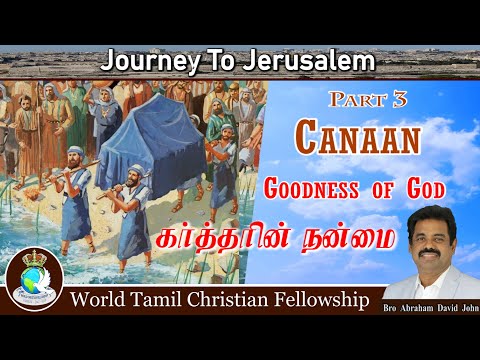
Goodness of God
Joshua 3:1
For many months, the people of Israel have been encamped at Shittim. From there they have conquered the Ammonite kings Og and Sihon on the east side of the Jordan (where the tribes of Reuben, Gad, and part of Manasseh have settled).
At Shittim, they have heard Moses recite the Law to them (contained in Deuteronomy, which means "second law"). But now it is time to go. They move only the six or seven miles from Shittim to a new encampment right on the banks of the Jordan River.
Here they stay for three days.
Breaking Camp
Joshua 3:1, Then Joshua rose early in the morning; and they set out from Acacia Grove and came to the Jordan, he and all the children of Israel, and lodged there before they crossed over. Why should they break camp to move such a short distance and stay such a short time?
But the reason is obvious. In Shittim, they had settled in. They had been there for months, perhaps years, and were too accustomed to sedentary camp life. To take possession of the Promised Land, they need to regain their pilgrim stance once more. They need to be ready to move!
When we are too comfortable with things in our lives or perhaps have accepted the compromises for too long it is difficult to make the changes necessary to re-align ourselves with God's will. We need change and the uncertainty that goes with it to become re-dependent upon God.
Certainly, that is what the people of Israel need at this point. So, they finally break camp. It may have taken several days to get ready. But finally, the two silver trumpets sound (Numbers
10:1), and the call is heard
Numbers 10:35, "Rise up, O LORD! May your enemies be scattered; may your foes flee before you."
It is a short trip, just a few miles, and that night they encamp on the very banks of the Jordan and peer across the flooded river in the gathering dusk to the city of Jericho beyond it. Consecrate yourselves Instead of making an immediate crossing, however, there is a three-day wait, and then a call for consecration. Joshua commands the people,
Joshua 3:5, And Joshua said to the people, “Sanctify yourselves, for tomorrow the Lord will do wonders among you.”
This consecration is probably similar to that which took place at the foot of Mount Sinai prior to entering into Covenant with God.
Exodus 19:10-11, 14-15, 10 Then the Lord said to Moses, “Go to the people and consecrate them today and tomorrow, and let them wash their clothes. 11 And let them be ready for the third day. For on the third day the Lord will come down upon Mount Sinai in the sight of all the people. 14 So Moses went down from the mountain to the people and sanctified the people, and they washed their clothes. 15 And he
said to the people, “Be ready for the third day; do not come near your wives.”
What significance did washing have? Spiritual cleansing. If you have ever camped in a tent, you know how dirty you can get and how glad you are for a shower. A pile of dirty clothes goes into the washer. However, the people of Israel may have had only a single set of clothes to wear.
So, when they wash their clothes, it is a major undertaking. Perhaps it included bathing, too, though that isn't specifically mentioned. Abstaining from sexual relations was so that the people would be ceremonially clean. Not that there was anything wrong with married sex.
Leviticus 15:18, "When a man lies with a woman and there is an emission of semen, both must bathe with water, and they will be unclean till evening"
This was necessary, for example, to partake of holy things. Those going into battle in David's day abstained from sex because they were on a holy mission (1 Samuel 21:4-5), which fits the situation at Jericho exactly.
So often, we attempt to undertake holy ministry without adequate preparation and consecration. The result is powerlessness and sometimes disgrace. Our consecration is not primarily outward, as it was for the Old Testament people, it is inward and spiritual.
Having been involved in "professional"ministry, I know how easy it is to take ministry for granted and do it with little thought of the holy things we are touching.
Luke 9:23, "If anyone would come after me, he must deny himself and take up his cross daily and follow me" That daily consecration and renewal of death to self is essential for ministry with power. Why did the Israelites need to consecrate themselves? In what ways do you personally need to reconsecrate yourself?
What would this require of you? What would your congregation need to do to reconsecrate itself? The Ark Goes Before
Joshua 3:3-4, and they commanded the people, saying, “When you see the ark of the covenant of the Lord your God, and the
priests, the Levites, bearing it, then you shall set out from your place and go after it. 4 Yet there shall be a space between you and it, about two thousand cubits by measure. Do not come near it, that you may know the way by which you must go, for you have not passed this way before.”
Joshua instructs the people to watch the ark, to see where it goes, and to follow it. The ark probably only moved a few hundred feet from where it had been located during the brief encampment, but the people were to follow it.
Ever since the people had been given the ark and tabernacle in the wilderness, when the cloud lifted and moved forward, that was the signal for the people to pack up and follow, to go where God was leading.
Today the ark -- the symbol of the throne of God -- indicates where they were to go. Notice the sense of awe and holiness
about the ark
"Keep a distance of about a thousand yards between you and the ark; do not go near it."(Joshua 3:4) The obvious lesson for us is that we are to see what God is doing and then follow Him. This was Jesus'practice, too.
John 5:19, "I tell you the truth, the Son can do nothing by himself; he can do only what he sees his Father doing, because whatever the Father does the Son also does." Too often, like little children on a walk, we run on ahead. Instead of being followers of our Father, we want to be leaders. Not so, Jesus. Before taking important steps, such as appointing the apostles, He spends the night in prayer. He often retreats from the crowds to spend time with His Father, to pray, and get His bearings. Are you following him or off on your own?
The lesson of the ark going ahead of us is a reminder to come back from our wanderings and to take our appointed place -- following God.
The Water Stopped Flowing
Joshua 3:14-17, So it was, when the people set out from their camp to cross over the Jordan, with the priests bearing the ark of the covenant before the people, 15 and as those who bore the ark came to the Jordan, and the feet of the priests who bore the ark dipped in the edge of the water (for the Jordan overflows all its banks during the whole time of harvest), 16 that the waters which came down from upstream stood still, and rose in a heap very far away at Adam, the city that is beside Zaretan. So the waters that went down into the Sea of the Arabah, the Salt Sea, failed, and were cut off; and the people crossed over opposite Jericho. 17 Then the priests who bore the ark of the covenant of the Lord stood firm on dry ground in the midst of the Jordan; and all Israel crossed over on dry ground, until all the people had crossed completely over the Jordan. If you had been one of the Israelite children, you would have asked your mother, "How are we going to get across the flooding river?" Your mother would probably look at you and say, "God will make a way."
But there is no way. The Jordan River is at full flood stage in the spring, carrying the runoff of more than 7,000 square miles (18,300 square kilometres) of territory, including the west side
of Mount Hermon in the north, the mountains around Galilee, and the east side of Canaan's hill country. Rainfall in Palestine is primarily in the winter months. The "early rains"("former rains") fall in October, with most precipitation occurring from December through February. The "latter rain"
occurs in April. The Scripture says, "Now the Jordan is at flood stage all during the harvest"(Joshua 3:15), speaking of the barley harvest which took place in April following the spring rains. April was also the month of Passover (Joshua 5:10).
If the fords were flooded, the spies would have had enough trouble swimming across to carry out their intelligence mission. Getting the whole army across would be difficult, dangerous, and make them vulnerable to attack.
But how do you get the women and children across? The only answer the mother could give was, "God will make a way."And that's often the only way we know how to answer our own doubts and fears. "God will make a way." This was a crucial test of Joshua's leadership.
Joshua 3:13, And it shall come to pass, as soon as the soles of the feet of the priests who bear the ark of the Lord, the Lord of all the earth, shall rest in the waters of the Jordan, that the
waters of the Jordan shall be cut off, the waters that come down from upstream, and they shall stand as a heap.” It was a faith statement for Joshua, and he delivered it to the people as he had received it from God. Then he announced the crossing, based on God's word that he would perform a miracle.
God did, just as He had for Moses at the Red Sea, a generation before.
How did God stop the waters? We are not told specifically except that,
Joshua 3:15-16, and as those who bore the ark came to the Jordan, and the feet of the priests who bore the ark dipped in the edge of the water (for the Jordan overflows all its banks during the whole time of harvest), 16 that the waters which came down from upstream stood still, and rose in a heap very far away at Adam, the city that is beside Zaretan. So the waters that went down into the Sea of the Arabah, the Salt Sea, failed, and were cut off; and the people crossed over opposite Jericho. A miracle!
The miracle is in the timing. God tells Joshua what he is going to do. Joshua tells the people what will happen. The priests come to the edge of the river, and just as they get there, the river stops flowing. A genuine miracle.
The people of Israel cross the Jordan River on dry ground, just as their parents crossed the Red Sea, wondering at and celebrating the awesome power of their God. Standing in the Water.
Joshua 3:8, You shall command the priests who bear the ark of the covenant, saying, ‘When you have come to the edge of the water of the Jordan, you shall stand in the Jordan.’ ”
The water didn't stop until the priests'feet touched it. Sometimes, God's miracles take place ahead of us. The Red Sea was parted, and then the people of Israel went through. But sometimes, God waits for us to take steps of faith before the miracle begins.
Jesus encountered some lepers along the border between Galilee and Samaria.
Luke 17:11-14, Now it happened as He went to Jerusalem that He passed through the midst of Samaria and Galilee. 12 Then as He entered a certain village, there met Him ten men who were lepers, who stood afar off. 13 And they lifted up their voices and said, “Jesus, Master, have mercy on us!” 14 So when He saw them, He said to them, “Go, show yourselves to the priests.” And so it was that as they went, they were cleansed. If they had waited to be cleansed before starting their journey, if the priests had waited for the waters to stop before taking the next step, they would all be waiting still. Sometimes, we must do all we know to do, and then God does what only He can do. Perhaps you are in that kind of place right now. You feel God is leading you to take a step that will make you look foolish, vulnerable, and you are afraid to take it.
Now you know what Joshua felt like. But he did what God told him to do, and announced what God had promised to do, and God came through for him. We like to see it before we believe it. But faith believes before it sees.
2 Corinthians 5:7, "We walk by faith, not by sight"
Not because this is our way, but because it is His way. How was Joshua able to announce the miracle of Jordan stopping its flow ahead of the event? What kind of faith did it require to do so? What did this do for his credibility as a leader?
Twelve Memorial Stones
Joshua 4:3, and command them, saying, ‘Take for yourselves twelve stones from here, out of the midst of the Jordan, from the place where the priests’ feet stood firm. You shall carry them over with you and leave them in the lodging place where you lodge tonight.’ ”
When their descendants ask, "What do these stones mean," they are to answer,
Joshua 4:7, Then you shall answer them that the waters of the Jordan were cut off before the ark of the covenant of the Lord; when it crossed over the Jordan, the waters of the Jordan were cut off. And these stones shall be for a memorial to the children of Israel forever.”
Joshua 4:22-23, then you shall let your children know, saying, ‘Israel crossed over this Jordan on dry land’; 23 for the Lord your God dried up the waters of the Jordan before you until you had crossed over, as the Lord your God did to the Red Sea, which He dried up before us until we had crossed over,
We see several stone memorials placed in Old Testament days. Jacob sets up a stone at Bethel after God revealed to him in a dream that he had not deserted him.
Genesis 28:16-17, Then Jacob awoke from his sleep and said, “Surely the Lord is in this place, and I did not know it.” 17 And he was afraid and said, “How awesome is this place! This is none other than the house of God, and this is the gate of heaven!” After the massing Philistine armies had been destroyed by a thunderstorm, Samuel sets up a stone and names it Ebenezer ("stone of help").
1 Samuel 7:12, Then Samuel took a stone and set it up between Mizpah and Shen, and called its name Ebenezer, saying, “Thus far the Lord has helped us.” Memorials give us -- and future generations -- points of reference, so we don't forget the significance of God's past dealings with us. Nor are these memorials always set in stone. After the Exodus, God instructs the people to remember their deliverance out of Egypt through the Passover feast. To this very day, on Passover night, Jewish families prompt the youngest child to ask the ancient question, "Why is this night different from all other nights?"And the father replies by telling the story of God's great redemption, of the sacrificial blood of a lamb on each Israelite doorpost and lintel, of bread dough freshly made "before the yeast was added"(12:34), and of the awesome crossing through the Red Sea. Unleavened bread reminded them of God's deliverance, much as the Lord's Supper reminds us of Jesus'suffering on our behalf. The bread reminds us of his body broken for us. "Do this in remembrance of me"(Luke 22:19). His blood "poured out for many, for the forgiveness of sins" (Matthew 26:28).
Memorials are part of our faith for they produce the thankfulness so necessary to true faith. Remembrance and Thanksgiving are what separate whining prayer from the prayer of faith that God answers.
Philippians 4:6-7, Be anxious for nothing, but in everything by prayer and supplication, with thanksgiving, let your requests be made known to God; 7 and the peace of God, which surpasses all understanding, will guard your hearts and minds through Christ Jesus. Sometimes, however, memorials move beyond the role of prompting remembrance into veneration, in and of themselves. That was the case with the bronze snake Moses had made. Within a few hundred years, Israelites were burning incense to it (Numbers 21:4-9; 2 Kings 18:4).
The magnificent cathedral in Cologne, Germany, houses a gilded reliquary box, purported to contain the bones the Three Magi. In the Middle Ages, it attracted crowds of pilgrims who came to pray near these relics and expect a miracle. Their bones no longer served as memorials to faithful believers in the new- born Messiah, rather, their bones had become objects of worship -- along with the very real danger of idolatry.
God used Gideon to defeat the huge Midianite army with just 300 men. Afterwards, however, he fashioned a gold ephod with the plunder that became much more than a memorial of victory.
Judges 8:27, "All Israel prostituted themselves by worshipping it there, and it became a snare to Gideon and his family" God-ordained memorials point to Him, not to themselves. Why did Joshua have men from each tribe stack river boulders for a monument?
What was the effect of this on future generations? What is the value of faith monuments in our day?
What is the danger? The LORD exalted Joshua Before the Jordan crossing, God has told Joshua,
Joshua 3:7, "Today I will begin to exalt you in the eyes of all Israel, so they may know that I am with you as I was with Moses." After the crossing we read,
Joshua 4:14, "That day the LORD exalted Joshua in the sight of all Israel; and they revered him all the days of his life, just as they had revered Moses."
This passage troubles us because we Christians are sometimes cynical about prominent leaders. We have seen too many topple from very visible public roles due to moral failure. God himself exalts some people so that He might use them as leaders of His people.
For forty years the people had followed Moses in their wilderness journeys. They grumbled, perhaps, but still followed, because of the way God had exalted him. Joshua is about to lead the Israelites into battle. Unless the people are prepared to follow him unquestioningly, they will fail in their mission. God calls some people to be strong leaders to accomplish his purposes.
But these same leaders are not perfect. Pastors are chief among those who have failings. People place pastors and their families on a pedestal, view them scrupulously and seem surprised to find imperfections. We must learn that God exalts some so He may lead His people by means of them. It is not for us to cut them down to size. That is for God to do.
God has had experience with Moses and Saul and David, and He will deal with your pastor too when he needs it.
Leaders are called to a higher standard and will be accountable for their actions.
1 Timothy 5:17-22, Let the elders who rule well be counted worthy of double honour, especially those who labour in the word and doctrine. 18 For the Scripture says, “You shall not muzzle an ox while it treads out the grain,” and, “The labourer is worthy of his wages.” 19 Do not receive an accusation against an elder except from two or three witnesses. 20 Those who are sinning rebuke in the presence of all, that the rest also may fear. 21 I charge you before God and the Lord Jesus Christ and the elect angels that you observe these things without prejudice, doing nothing with partiality. 22 Do not lay hands on anyone hastily, nor share in other people’s sins; keep yourself pure. Sometimes I have wondered about leaders who have more prominence than I.
Why are they so special?
Are they better than the rest? No, I don't think so.
Sometimes they have glaring flaws. But God chooses to exalt them and use them to lead His people to accomplish His purposes. Instead of envying or grumbling, I need to accept that, pray for them, and follow them. Exaltation to leadership is a perk not based on merit, but it is a gift from God to the body, that leaders might lead God's people to do His will.
Circumcision and Passover
Joshua 5:1-11 On the east bank of the Jordan, the people consecrated themselves. On the west bank, they do so again. This is not yet the time to attack Jericho -- there is still spiritual preparation to take place. I'm often more eager to achieve the goal than to do the careful work of heart preparation necessary to achieve it. This passage reminds me to do first things first. To do things I may have put off for years. An entire generation of Israelite boys had grown up uncircumcised. Circumcision was the mark that a man was a part of the Covenant People. God had first given this command to Abraham, 450 years prior to crossing the Jordan.
Genesis 17:10-11, "This is my covenant with you and your descendants after you, the covenant you are to keep: Every male among you shall be circumcised. You are to undergo circumcision, and it will be the sign of the covenant between you and me." While the Israelites had apparently practiced circumcision of boys on the eighth day while in Egypt, for some reason during their wilderness journeys they had not maintained the practice.
Joshua 5:5, A whole generation of men and boys were uncircumcised. To partake of Passover required the circumcision of all male participants (Exodus 12:48), and the time for Passover had come.
Joshua 5:9, "The LORD said to Joshua, 'Today I have rolled away the reproach of Egypt from you.'"
The word "roll"(Hebrew galal) sounds something like Gilgal, the name they gave the place after this event.
What was the "reproach of Egypt"? It wouldn't have been the disapproval of their Egyptian captors toward circumcision.
The Egyptians practiced circumcision themselves. Perhaps it was the shame of the true People of God being uncircumcised for forty years while Egyptians themselves did not neglect the practice. Perhaps it refers not so much to circumcision as to their finally being across Jordan in the Promised Land, forty years after they had left Egypt for this destination. (Numbers 14:13-16;
Deuteronomy 9:28). However, we interpret the verse, it doesn't have much bearing on our understanding of the whole passage.
The point here is that we may some catching up to do. We have a way of putting off prerequisites -- we can do them later. But there comes a time when we must do the will of God so that we might experience his blessings for us. In this case, the boys and men were all circumcised so they might partake in the blessing of Passover, and the Unleavened Bread prepared with flour from the harvest of the Promised Land.
The Manna Ceased
Joshua 5:12, Then the manna ceased on the day after they had eaten the produce of the land; and the children of Israel no longer had manna, but they ate the food of the land of Canaan that year.
Our lesson ends with just a single verse to mark the termination
of a forty-year miracle
Joshua 5:12,"The manna stopped the day after they ate this food from the land; there was no longer any manna for the Israelites, but that year they ate of the produce of Canaan".
When it had first been given, the manna had been a lifesaver. The Israelites had no food and no way to coax enough nutrition from the desert to feed a million and a half people. So, God sent them manna. It appeared each morning except on the Sabbath as flakes of frost on the desert floor, and they would collect it in baskets to feed their families.
Exodus 16:31,"It was white like coriander seed and tasted like wafers made with honey." For forty years God provided manna as the Israelites'staple food, even after they got tired of eating it and complained about it.
Numbers 11:4-6, Now the mixed multitude who were among them yielded to intense craving; so the children of Israel also wept again and said: “Who will give us meat to eat? 5 We remember the fish which we ate freely in Egypt, the cucumbers, the melons, the leeks, the onions, and the garlic; 6 but now our
whole being is dried up; there is nothing at all except this manna before our eyes!” We see some other examples of a special provision in the Bible. God sent a raven to feed Elijah during a severe famine.
1 Kings 17:4-6, And it will be that you shall drink from the brook, and I have commanded the ravens to feed you there.” 5 So he went and did according to the word of the Lord, for he went and stayed by the Brook Cherith, which flows into the Jordan. 6 The ravens brought him bread and meat in the morning, and bread and meat in the evening; and he drank from the brook. Later brought him to the home of a widow who only had enough flour and oil for one last meal to feed herself and her son. But because God touched it!
1 Kings 17:16, The bin of flour was not used up, nor did the jar of oil run dry, according to the word of the Lord which He spoke by Elijah.
I expect that after a while, the Israelites began to take manna for granted. They take it as the natural course of events, whereas it is a very special provision for a special time in the formation of God's people. Then there is the day when the manna stops (Joshua 5:12).
The people are frightened. Maybe it's the Sabbath, they speculate. But the next day there isn't any manna either. And it never ever comes again. It is God's provision for a special time, and now it is no longer needed. Now the Israelites can eat the produce of the tilled field, and the need for special provision ceases.
We often take God's supernatural provisions for granted. What about the Holy Spirit's presence with us? Too often we are unappreciative and unthankful.
We act as if we have no clue about the price paid so that the Holy God could live within our mortal bodies and allow us to commune readily at his very throne. We must not take God's miracles for granted. Have you ever observed how marvellously God sometimes reveals himself to brand new Christians?
They will see miracles and perform exploits that have the older saints scratching their heads in wonder. But later, comes a time when they, too, must learn some of the difficult lessons of faith and patient endurance, and the miracles they took for granted are now withheld from them.
An experience of forsakenness, where you don't feel God's presence or experience Him like you once did. The joy of the Lord you once knew has dried up, and you learn to go on faith alone, unpropped by supports of outward emotion and inner assurance.
This is real, and much more common that many are willing to admit. It is also designed by God to draw us closer to him and to strengthen our faith. When we do come out of this wilderness time, we are the stronger for it and have learned to walk with God in a new dimension. Too often we take God's blessings for granted.
There's a second lesson here, too, that God's supernatural provision may only be for a time. There is a season to gather the bread from heaven, and there is also a season to undertake the hard labour of tilling and sowing, of tending and reaping.
Genesis 3:19, "By the sweat of your brow you will eat your food"
The Christian life includes times of abundance as well as hunger, of nakedness as well as being fully clothed. Lest we look down on our brothers and sisters who are undergoing difficulty.
Deuteronomy 8:11-18, “Beware that you do not forget the Lord your God by not keeping His commandments, His judgments, and His statutes which I command you today, 12 lest—when you have eaten and are full, and have built beautiful houses and dwell in them; 13 and when your herds and your flocks multiply, and your silver and your gold
are multiplied, and all that you have is multiplied; 14 when your heart is lifted up, and you forget the Lord your God who brought you out of the land of Egypt, from the house of bondage; 15 who led you through that great and terrible wilderness, in which were fiery serpents and scorpions and thirsty land where there was no water; who brought water for you out of the flinty rock; 16 who fed you in the wilderness with manna, which your fathers did not know, that He might humble you and that He might test you, to do you good in the end— 17 then you say in your heart, ‘My power and the might of my hand have gained me this wealth.’ 18 “And you shall remember the Lord your God, for it is He who gives you power to get wealth, that He may establish His covenant which He swore to your fathers, as it is this day.
Even though some "name it and claim it"teachers declare poverty as a curse, poverty is not necessarily a sign of lack of faith (though it can be). Poverty is sometimes our lot. The Apostle Paul, certainly no slouch when it came to faith, recounts his sufferings (2 Corinthians 11:22-28).
Philippians 4:11-13, Not that I speak in regard to need, for I have learned in whatever state I am, to be content: 12 I know how to be abased, and I know how to abound. Everywhere and in all things I have learned both to be full and to be hungry, both
to abound and to suffer need. 13 I can do all things through Christ who strengthens me.
So where are you? Are you in a time of manna in your life? Or do you have to work very hard for your daily bread?
Are you going through a time of consecration? Don't despair. Even though we go through times of change, God is still with us to provide for us. By natural means and spiritual, our God is leading us as we walk along with him.
Whether in the Wilderness or the middle of the Jordan or in the Promised Land, he has given us this unshakable word.
Joshua 1:9, Have I not commanded you? Be strong and of good courage; do not be afraid, nor be dismayed, for the Lord your
God is with you wherever you go.”
Joshua 1:5, No man shall be able to stand before you all the days of your life; as I was with Moses, so I will be with you. I will not leave you nor forsake you.
Conclusion
Joshua and Caleb were the only adult Israelites in that first generation who went "into the fullness"of God's calling. They alone went into the land.
Numbers 14:29-30, The carcasses of you who have complained against Me shall fall in this wilderness, all of you who were numbered, according to your entire number, from twenty years old and above. 30 Except for Caleb the son of Jephunneh and Joshua the son of Nun, you shall by no means enter the land which I swore I would make you dwell in. Joshua would not only enter the land, but he would also lead Israel into God's victory.
Deuteronomy 31:7, Then Moses called Joshua and said to him in the sight of all Israel, “Be strong and of good courage, for you must go with this people to the land which the Lord has sworn to their fathers to give them, and you shall cause them to inherit it. Caleb would not only enter the land, but he would also still be strengthened by faith in God even in his old age.
Joshua 14:11, As yet I am as strong this day as on the day that Moses sent me; just as my strength was then, so now is my strength for war, both for going out and for coming in. Unlike Joshua and Caleb, the other Israelites followed the Lord's calling out from Egypt, but they did not follow Him into the land. Many Christians repeat this same error today.
They have followed the Lord as He led them out of the spiritual death of sin and guilt. They are "out of Egypt." They are forgiven of their sins. They have new life in Christ. However, they do not follow the Lord on "into the land."They do not follow by faith into abundance of life. They do not follow the Lord in humble dependence for transformation, for fruitfulness, for a life of spiritual victory.
The Tribes of Israel and their Lands Eventually Joshua gave different parts of the land of Canaan to each of Israel’s twelve tribes (Joshua 13—21). These tribes were like big extended families, with the oldest male (father) serving as the centre of authority. As the tribes
took ownership of their pieces of land, they settled down to build towns, grow crops, and raise herds of sheep and goats. The land these tribes owned was believed to have been assigned by God, and so no one was to sell or give their property to anyone else. If that did happen, the land was to eventually be given back to the tribe God first gave it to. This would happen during the Year of the Celebration which was celebrated approximately every fifty years (Leviticus 25:8-17,23-28).
The tribe of Levi did not get their own land, because they were given a special task and would not be farmers or herders. The Law of Moses said they would be in charge of offering sacrifices to God (Deuteronomy 18:1). The other tribes were to provide these sacrifices, and the Levites were allowed to keep some of the food sacrifices for themselves. Thus, the Levites (priests from the tribe of Levi) had an important place as the religious leaders of the other tribes: they would be the priests for all Israel.
Even though the twelve tribes were scattered in different areas around Canaan, they shared a common history and followed the Law of Moses.
Just before Joshua died, he called all the tribes together for a meeting at Shechem. He challenged them to remain faithful to God and never to worship other gods (Joshua 24:14-24). The people promised to remain faithful, and Joshua set up a stone as a witness to their promises (Joshua 24:25-27).
Lessons for Disciples Disciples can glean several lessons from this passage. God often must break our established routines so that we are alert and ready to listen to Him and obey (3:1). Sometimes God calls us to consecrate ourselves afresh, to receive his cleansing so that we're ready to serve Him in holiness (3:5).
The ark going before the people is symbolic of us needing to learn to follow the Lord, rather than run ahead. Discipleship is learning and following.
Sometimes God doesn't send His miracles until we, in faith, are fully committed and obedient (3:8, 15-17). Godly leadership sometimes requires us to state in advance what God shows us He will do, and then lead our people personally into that future (3:13-17) Having monuments to God's faithfulness that we can look back on can encourage our faith for the future (chapter 4).
God sometimes exalts his leaders so that they can effectively lead. So, this won't turn into personal pride, we must be careful to continue in humility before Him (4:14) God is able to provide for His people (such as with manna for food).
But His special provisions sometimes end when we move into new phases of discipleship and responsibility (5:12).